
The decision that will define your legacy, your valuation, and your freedom
A 2023 report from the Exit Planning Institute reveals that a staggering 75% of business owners want to exit their business in the next 10 years, with 49% wanting to exit in the next 5 years.
When asked if they prefer an internal or external transition, 70% of owners prefer an internal option, with a desire for a family transition representing about half of business owners.
What is an internal transition vs. a third-party sale? Why would you choose one over the other? And how do you prepare for the sale of your business?
What is an internal transition?
Most internal, or inside, transitions fall into one of four categories. They are:
- Intergenerational transfer: Transfer of business stock to direct heirs
- Management Buyout (MBO): Sell all or part of stock to management team
- Sell to employees (ESOP): The company uses borrowed funds to acquire shares from the owner and contributes the shares to a trust on behalf of the employees
- Sell to existing partners: Sell ownership stake to one or more existing partners
Pros and cons of intergenerational transfer (Snider, 2023)
| Pros | Cons |
| Business legacy preservation | Family dynamics |
| Planned | Illiquid buyers/lack of funds |
| Lower cost | Lower sale price |
| More control | Key employee flight risk |
| Less disruption | Tradition may outstrip good strategy |
| High buyer/seller motivation | Path of least resistance – but not always a path to growth or success |
Pros and cons of management buyout
| Pros | Cons |
| Continuity | Management “sandbagging” |
| Highly motivated buyers (pent-up desire) | Distraction |
| Preserved key human capital/knowledge | Threat of flight (coercion of owner) |
| Planned | Lower price and unattractive deal terms for seller |
| Can be combined with private equity to access additional capital and resources for growth | Heavy seller financing introduces risk |
| Managers are not always good entrepreneurs |
Pros and cons of sale to existing partners
| Pros | Cons |
| Less disruptive | Lower sales price |
| Planned | Potential discord |
| Well-informed buyers | Competency gaps |
| Controlled process – if buy-sell agreement in place and funded | Buy-sell may restrict selling options |
| Lower cost | Realization of proceeds from sale is often slower (and less) |
Pros and cons of selling to employees (ESOP)
| Pros | Cons |
| Business stays in the “extended family” | Complicated and expensive |
| Shares purchased with pre-tax dollars by the ESOP | Requires securities registration exemption |
| Taxable gain on the shares sold to the ESOP by the owner may sometimes be deferred | Company compelled to buy back shares from departing employees |
| ESOP is an employee benefit | Generally suitable only for gradual exit over time |
| May cause employees to think and act like owners |
What is an external transition?
Most external or outside transfers fall into these categories
- Sale to a third-party: The owner sells the business to a strategic buyer, financial buyer, or private equity group usually through a negotiated sale, controlled auction, or unsolicited offer
- Recapitalization: The owner brings in a lender or equity partner to “fund the company’s Balance Sheet”; this can be a minority or majority position
- Orderly liquidation: The company shuts down and assets are sold
Pros and cons of a third-party sale
| Pros | Cons |
| Higher price (highest of these options) | Long process (9-12 months) |
| More cash up front | Distraction/loss of focus |
| Walk away faster | Privacy concerns |
| Stability of deal terms | Emotional for owner |
| Business refresh (growth, new energy) | After-sale tie-downs |
| Cost effectiveBreaks deadlock at management level with family | Highest absolute cost of option (but with a higher benefit) |
| Complex process, involving about 1,000 professional hours | |
| Can be difficult to close |
One company has many values, depending on the buyer
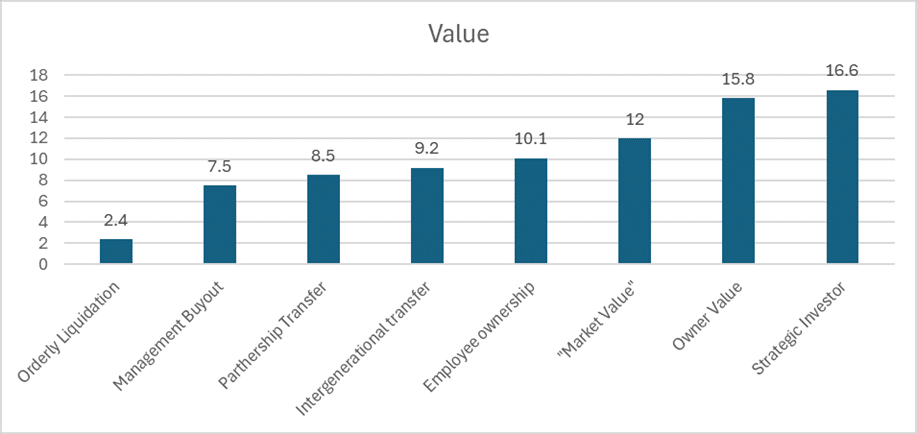
Graphic from Private Capital Markets, Robert T. Slee, 2011
Key takeaways from this chart:
- Owners tend to think their business is worth more than the market does
- Creating a bidding war with strategic investors is the way to get the highest valuation
- All internal transfer options are lower in price, and this may conflict with the owner’s financial needs
Data from the Exit Planning Institute shows that between 70% and 80% of business transitions fail. The most common reason is the owner gets cold feet, but other common reasons include:
- Business is highly owner-dependent
- Business lacks the talent needed to operate without the owner
- Business is too reliant on a few key customers
- Customer relationships are not sticky
- Business lacks structure in the form of standardized processes, procedures, and systems
- Business has high exposure to legal or liability risks
These issues are important for both internal and third-party sales. In third-party sales, the business may be deemed non-transferable, or the valuation will be significantly discounted. In the case of an internal transfer, the business is not being set up for success. This adds stress to the new management team, which could spill over to the family, and it puts the future income stream for the exiting owner (which is common in internal transitions) at risk.
How to prepare for internal transitions
- Choose the appropriate category (intergenerational, MBO, ESOP, sale to existing partners).
- Work with a financial planner, CPA/Tax advisor, and estate planning attorney to ensure the owner is financially prepared.
- Understand that each of the options can be complex and the owner/family should start working with appropriate advisors at least 3-5 years in advance
- Work with a trusted business advisor to identify challenges in the business that reduce its value or even prevent a successful transition.
- Extract owner from the day-to-day activities of running the business, so the team can develop. Have the owner focus on addressing the personal, financial, and business issues that will create value and ensure a successful transition for all parties.
- Strengthen operational systems, financial controls, and leadership depth to increase transferability and reduce risk.
Preparing for a third-party sale requires similar discipline. Financials must be clean and defensible. Revenue must be diversified. Leadership must be capable of operating independently. Buyers will scrutinize risk, systems, and sustainability. The more transferable the business, the stronger the valuation and deal terms.
The hard truth about transitions
Most owners think exit planning starts when they are ready to sell. It does not. The success of a transition is determined years before a deal is ever discussed.
Whether you pursue an internal transition or a third-party sale, the real question is this: Is your business transferable?
A transferable business:
- Operates without the owner at the center of every decision
- Has documented processes and measurable KPIs
- Is not dependent on a few key customers
- Has leadership capable of running the company independently
- Produces consistent, predictable cash flow
If those elements are missing, value drops and risk rises.
In a third-party sale, buyers discount the price or walk away. In an internal transition, the next generation inherits instability instead of strength.
The market does not pay for effort. It pays for structure, systems, and sustainable profit.
Exit planning is operational discipline
Succession is not a legal event. It is an operational transformation. Preparing for transition requires the same fundamentals that build a healthy, scalable company:
- Strong financial controls
- Clear accountability and leadership depth
- Diversified revenue
- Measurable performance systems
In short, the business must evolve beyond the founder.
And here is the unexpected benefit: when owners build a business that can run without them, their quality of life improves immediately. Stress decreases. Clarity increases. Time returns.
A transition-ready business is a freedom-ready business.
Exit on your terms
Transition planning should begin three to five years before exit. For many owners, the right time to start is now. Even if you never sell, preparing your company for transfer will:
- Increase enterprise value
- Improve profitability
- Strengthen leadership
- Protect your legacy
- Improve your quality of life
You will exit your business one day. The question is whether you will do it reactively or strategically. The difference is preparation.