By Andrew Acer
Why most business owners feel the weight of ownership, and how to take control
Running a business is not a single job.
From the day you open the doors, you inherit responsibility for every dimension of the enterprise, whether you were trained for it or not. As the business grows, those responsibilities do not shrink. They expand.
You can delegate tasks. You can build a team. You can create structure. But ultimately, the results still sit with you.
And that gap, between what ownership demands and what most owners were ever taught to manage, is where many business owners find themselves. Working harder than they expected, carrying more than they anticipated, and still feeling like something is missing.
Cogent Analytics exists to close that gap.
The framework we use to diagnose it, organize it, and address it is called the Profit Platform®.
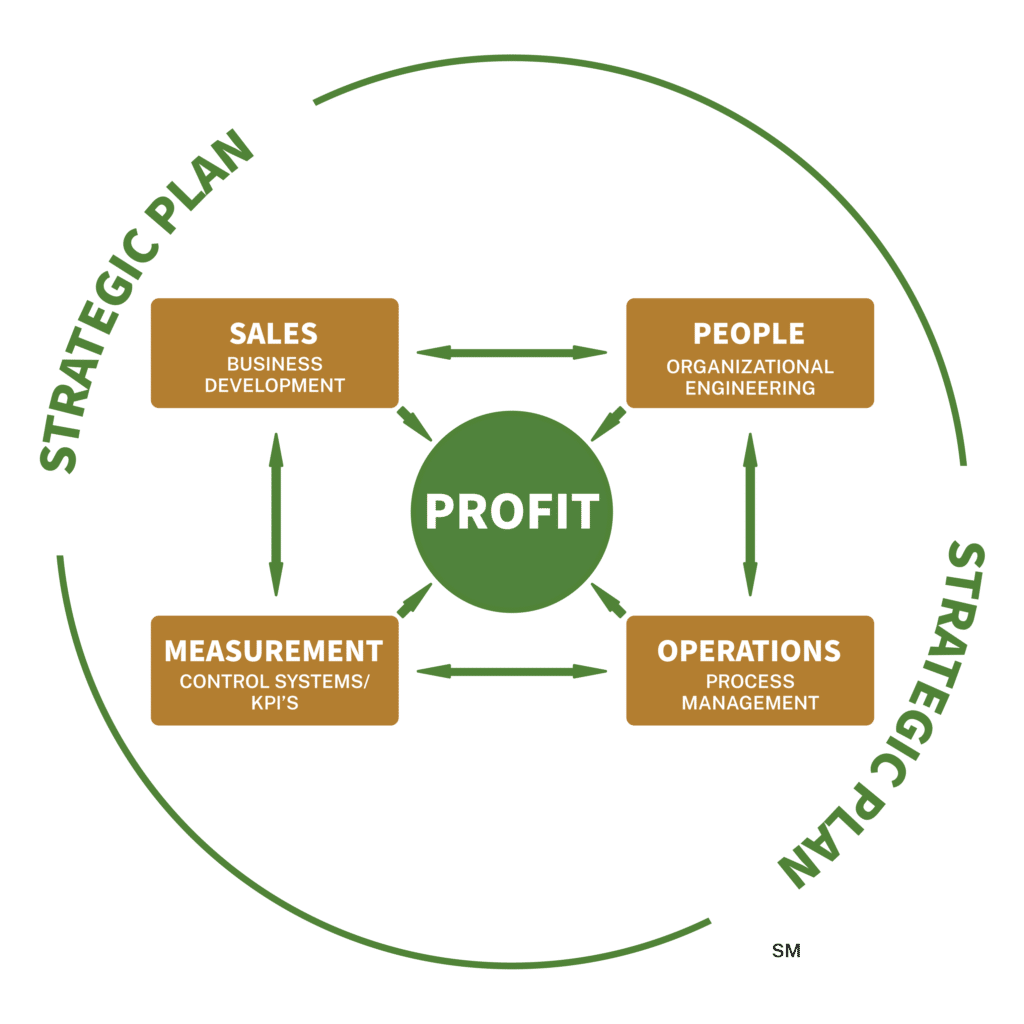
How the Profit Platform works
Before going further, it is important to understand how the Profit Platform is structured, because that structure is what makes it practical.
Each part of the framework operates on three levels:
- A clear, practical label that immediately resonates
- The broader business function it represents
- A single underlying idea that defines its purpose
You do not need to memorize that structure. But understanding it changes how you see your business. It moves you from reacting to problems to understanding how the pieces fit together.
At its core, the Profit Platform is built on a simple idea: The outcomes that matter most in a business are not accidental. They are engineered.
The five components of the Profit Platform
Every business we evaluate is organized into five core areas:
- Strategic Planning
- Sales
- Operations
- Measurement
- People
Each one plays a distinct role. All of them work together. And all of them ultimately drive one result: profit.
Strategic Planning sets the direction
Strategic planning is not just another function in the business. It is the context for everything else.
It defines:
- Why the business exists
- Where it is going
- How decisions should be made
A business operating with a clear, current strategic plan makes intentional decisions. A business without one reacts to whatever comes next.
Ambition is not the problem; most business owners have ambition. Most owners do not lack ambition. They lack a plan that is written, communicated, and actively used to guide the business.
Without that:
- People work without alignment
- Operations follow habit instead of direction
- Financial decisions are made in isolation or based on instinct
Strategic planning is what brings alignment across the entire business. Without it, every other area becomes weaker.
Ask yourself: Do I have a clear, written plan that my team understands and actually uses to make decisions, or are we reacting to what comes next?
Sales creates opportunity
Every business must bring work in the door.
Sales is the language most owners use. The broader reality is business development, which includes everything that drives revenue:
- Marketing and positioning
- Sales process and conversion
- Pricing strategy
- Forecasting and pipeline management
At its core, this area is about one thing: opportunity.
When sales is underdeveloped, the business becomes dependent:
- Dependent on referrals
- Dependent on a few key customers
- Dependent on pricing pressure
In that position, the business is not choosing its future. It is accepting whatever the market offers.
A structured approach to business development changes that.
It allows you to decide:
- Where you grow
- Who you serve
- What you charge
It also removes one of the most common constraints we see: when the owner is the primary driver of revenue. When that happens, growth is tied directly to your time and energy.
Ask yourself: Is my business built to generate revenue consistently and predictably without relying on me, or does the pipeline slow down when I step away?
Operations determines efficiency
Once the work is sold, it has to be delivered. Operations is the engine of the business.
It includes:
- Workflow and scheduling
- Process design and documentation
- Quality control
- Technology and systems
At its core, operations is about efficiency.
Not just getting the work done, but getting it done:
- Consistently
- On time
- At the right cost
- Without constant owner intervention
This is where many businesses quietly lose margin.
Rework, inconsistency, and lack of structure rarely show up clearly on a financial statement, but they show up in stress, delays, and reduced profitability.
When the owner is the one holding operations together:
- Every exception comes to you
- Processes live in people’s heads
- The business runs on your capacity, not on systems
Ask yourself: Can my business deliver consistently, on time, and at the right cost without me stepping in to solve problems, or does everything still run through me?
Measurement creates control
At any given moment, you should be able to answer a simple question: What is actually happening in my business right now?
Measurement is what makes that possible.
It includes:
- Financial reporting
- Job costing and margin visibility
- Cash flow tracking
- Key performance indicators
At its core, measurement is about control.
Without it:
- Decisions are made on instinct
- Problems are discovered too late
- Growth creates risk instead of confidence
Most owners receive financial information that is historical and compliance-driven. What they lack is forward-looking visibility. Without that, the business is being managed blindly. Pricing decisions, hiring decisions, and growth decisions are all being made without a clear picture of their impact.
Ask yourself: Do I have real-time visibility into what’s happening in my business and where we’re headed, or am I making decisions based on instinct and outdated information?
People determine scalability
Every part of the business depends on people. Sales requires a team. Operations requires execution. Measurement requires discipline. People are not just a resource. They are the multiplier.
This area includes:
- Organizational structure
- Leadership development
- Accountability systems
- Hiring and retention
- Succession planning
Most businesses at the stage we engage were built for a smaller, simpler version of themselves.
As a result:
- Roles are unclear
- Accountability is inconsistent
- Promotions are based on loyalty, not capability
- The owner steps in to fill gaps instead of building structure
The team that got you here is not always the team that will take you further.
Without structure, the owner becomes the default solution to every problem.
Ask yourself: Do I have the right people, structure, and accountability in place to grow without me, or am I still the one holding everything together?
Profit is the result
Profit is not a separate function in your business. It is the result of everything working together.
When…
- Sales creates opportunity
- Operations delivers efficiently
- Measurement provides visibility
- People execute effectively
- Strategy aligns it all
…then profit becomes predictable. Not something you hope for at year end, but something you drive every day. And profit is not just what reaches you as the owner.
It flows through:
- Taxes
- Debt
- Growth
- Working capital
Only then does it become a true return.
Most owners do not have clear visibility into that flow, or how decisions across the business affect it. Everything connects.
Ask yourself: Is my business being run in a way that consistently produces profit and gives me control over the outcome, or am I hoping the numbers work out at the end of the year?
The real question
The question is not whether your business made money last year. The question is whether it is being run in a way that:
- Maximizes its value
- Creates consistent profit
- Gives you control over the outcome
That is what the Profit Platform is designed to answer.
And once you see your business through that lens, you stop guessing and start building it intentionally.